
AAM BLOG
Published by AAM Network Inc. — Every Mile with a Smile
Every August, thousands of trucks get parked on the shoulder for the same reason they’ve been parked on the shoulder for the last thirty years: brakes.
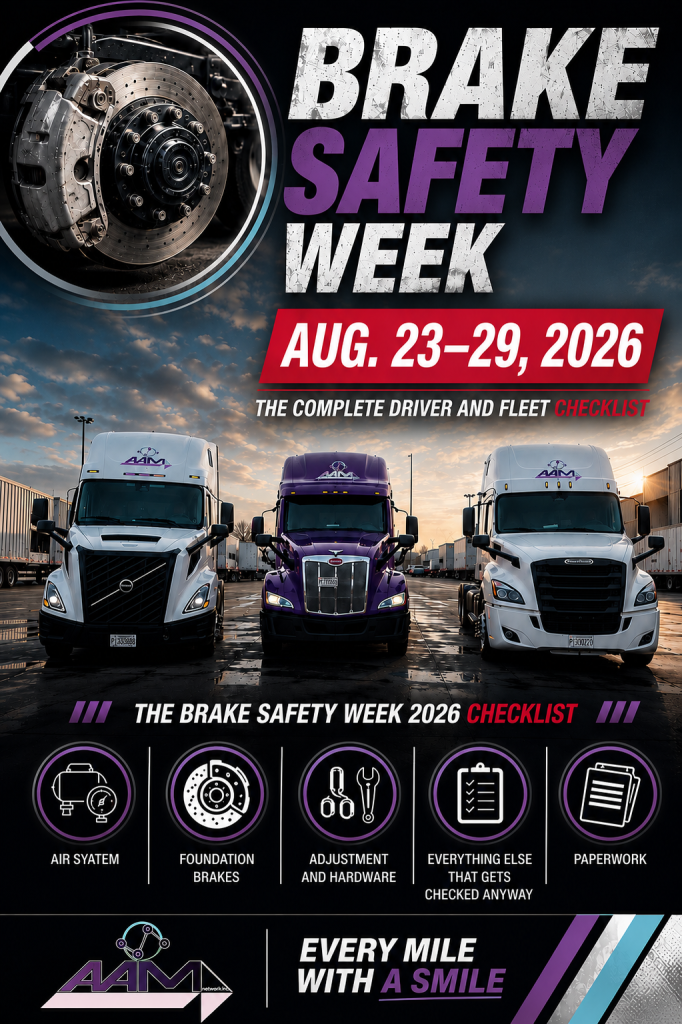
CVSA’s Brake Safety Week 2026 runs August 23–29 across the United States, Canada and Mexico. For one week, certified inspectors will pull commercial vehicles into weigh stations, fixed inspection sites and unannounced roadside checkpoints, and they will look hard at one system. If your drums are cracked or your rotors are worn past spec, you are not finishing that load on time.
At AAM Network Inc., safety isn’t a week on the calendar — it’s how we keep our Freightliners, Kenworths, Peterbilts, Internationals, Volvos and Macks earning instead of sitting. But Brake Safety Week is a useful deadline. Here’s exactly what inspectors are looking for in 2026, what the data says about your odds, and a checklist you can run before the campaign starts.
What Brake Safety Week Actually Is
Brake Safety Week is a seven-day enforcement and education initiative run by the Commercial Vehicle Safety Alliance (CVSA) under its Operation Airbrake program, in partnership with FMCSA, Transport Canada and local enforcement agencies.
A few things drivers should understand about how it works:
- It’s a Level IV inspection week. Most stops during the campaign are North American Standard Level IV Special Inspections — a targeted examination of one system rather than a full 37-step Level I. Inspectors can document brake condition in detail without running the full driver-and-vehicle review.
- It covers three countries. Inspectors in the U.S., Canada and Mexico all participate. In 2025, 52 jurisdictions took part.
- There’s a second, unannounced event. CVSA also runs a Brake Safety Day each year with no advance notice. The 2026 edition was held April 14. Assume the announced week is not your only exposure.
- The Out-of-Service Criteria change every April 1. The 2026 edition of the North American Standard Out-of-Service Criteria took effect April 1, 2026 and included approved changes affecting brake measurements, wheels and rims, coupling devices and more. Last year’s cheat sheet is not this year’s cheat sheet.
The 2026 Focus Area: Brake Drums and Air Disc Brake Rotors
For the second year running, CVSA has named brake drums and air disc brake rotors as the focus area. Inspectors will record condition data on these components on top of the standard brake inspection.
This matters because drum and rotor defects are not just a CSA-score problem. A broken piece of a drum or rotor can separate at highway speed and become a projectile — CVSA has been explicit that dislodged fragments can damage other vehicles and cause injuries or fatalities. That’s why several drum and rotor conditions are standalone out-of-service violations rather than something that only counts toward the 20% rule.
The specific conditions inspectors are trained to flag:
Brake drums
- An external crack, or visible cracks that open when the brake is applied
- A missing segment or piece that could break off
- Cracks running through to the outer portion of the drum
- Wear beyond the manufacturer’s maximum diameter
Air disc brake rotors
- Cracks or broken pieces in the friction surface
- Severe rust across the entire friction surface on either side (light surface rust is acceptable — a rotor rusted solid usually means the brake is inoperative)
- Grooving that indicates metal-to-metal contact from pads worn through
- Wear that has exposed the center vents
The relevant regulatory citations, if you want them for your DVIR notes or a DataQ challenge: 49 CFR 393.47(a) (broken drum, cracked rotor), 393.47(g) (worn rotor), 393.48(a) (metal-to-metal contact, rusted rotor).
The Numbers: What the Data Actually Says
If you think brake enforcement is overblown, the statistics disagree.
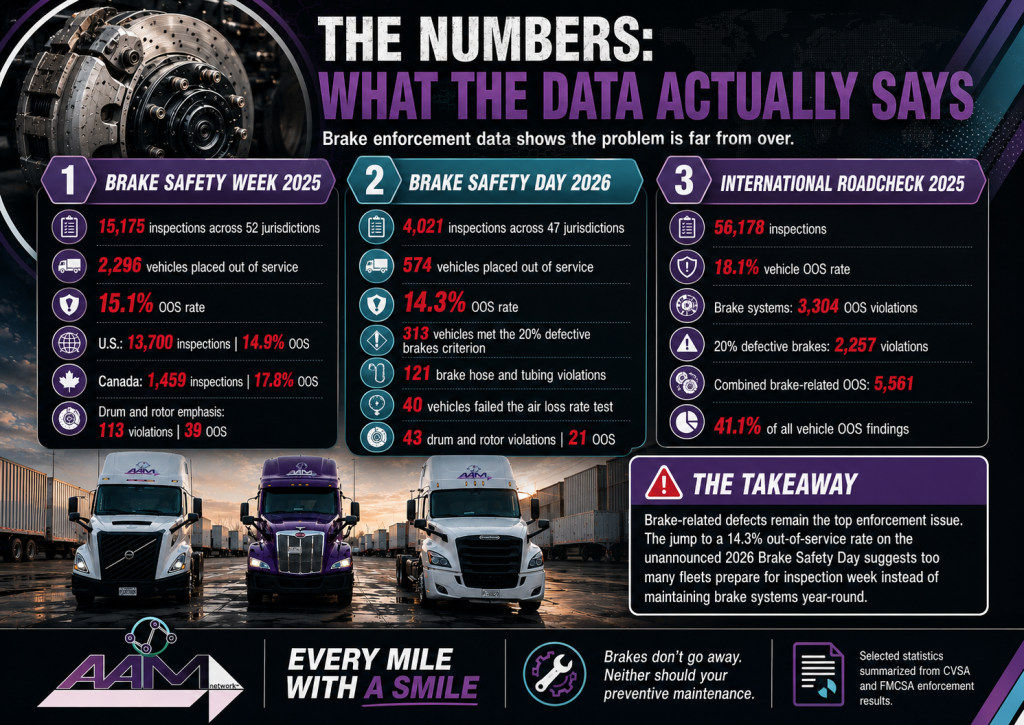
Brake Safety Week 2025 results
- 15,175 commercial vehicles inspected across 52 jurisdictions
- 2,296 placed out of service for brake-related violations — a 15.1% OOS rate
- U.S.: 13,700 inspections, 2,035 OOS (14.9%)
- Canada: 1,459 inspections, 260 OOS (17.8%)
- Drum and rotor emphasis produced 113 violations, with 39 vehicles placed out of service
The 15.1% rate was essentially flat against 2024’s 15%, and up from 12.8% in the 2024 campaign year — meaning the industry is not improving on this.
Brake Safety Day 2026 (April 14, unannounced)
- 4,021 inspections across 47 jurisdictions
- 574 vehicles placed out of service — a 14.3% OOS rate, up sharply from 8.7% the previous year
- 313 vehicles met the 20% defective brakes criterion — the single largest violation category of the day
- 121 OOS violations for brake hoses and tubing
- 47 steering axle brake violations
- 40 vehicles failed an air loss rate test
- 43 drum and rotor violations, 21 of them out-of-service
- Ten U.S. jurisdictions ran 349 performance-based brake tester (PBBT) inspections; 26 vehicles (7.45%) failed to meet the required 43.5% minimum braking efficiency
That jump from 8.7% to 14.3% on an unannounced day is the number worth sitting with. It suggests fleets prepare for the announced week and let things slide the rest of the year.
International Roadcheck 2025 — the wider picture
- 56,178 inspections; 13,553 vehicle out-of-service violations; 18.1% vehicle OOS rate
- Brake systems: 3,304 OOS violations — 24.4% of all vehicle OOS findings, the #1 category
- 20% defective brakes: 2,257 additional violations (16.7%)
- Combined: 5,561 brake-related OOS violations — 41.1% of everything
Brake-related defects have topped this list every single year. Focus areas rotate. Brakes don’t go away. FMCSA data also showed six of the top 20 vehicle violations in 2025 were brake-related — defective, worn, or out of adjustment.
For context, roughly 4 million commercial vehicle inspections are conducted across North America every year. Brake Safety Week is a spotlight, not the whole exposure.
Why an OOS Brake Violation Costs More Than a Tow Bill
Drivers tend to think of an out-of-service order as lost hours. Carriers should think about it as a line item that repeats for two years.
1. Immediate downtime. An OOS sticker goes on the windshield. Nobody may operate that vehicle — not even to the truck stop three miles down the road — until the defect is repaired and documented. That means a roadside service call at roadside service prices, a missed appointment, and a driver burning hours in a lot.
2. CSA damage that compounds. FMCSA’s Safety Measurement System assigns each violation a severity weight from 1 to 10, and any violation that results in an out-of-service order gets an additional weight of 2 added on. Brake violations already sit at the top of the Vehicle Maintenance BASIC severity table — brake hose or tubing chafing (393.45) and brakes out of adjustment (393.48(a)) carry a severity of 8, and insufficient braking force (393.52) carries a 10. These stay on your public record for 24 months.
3. Second-order costs. A rising Vehicle Maintenance BASIC means more frequent inspection selection at scales, harder insurance renewals, and brokers who quietly route freight elsewhere. For a small fleet or an owner-operator with few inspections on file, one bad inspection can push you over an intervention threshold.
4. The DVIR trap. One documented case involved a carrier that received a $77,000 fine after a driver correctly noted a brake defect on a DVIR — repeatedly — and the carrier kept dispatching the truck anyway for a month before repairing it. Writing the defect down and then ignoring it is worse than not writing it down. Close the loop.
The Brake Safety Week 2026 Checklist
A. Driver pre-trip and post-trip — every day, not just in August
Air system
- Build air pressure to governor cutout (roughly 120–135 psi), confirm the compressor cuts out and cuts back in
- Low-air warning device activates before pressure drops below 60 psi
- Static air leakage test — listen for audible leaks at chambers, fittings and glad hands
- Applied air leakage test — hold the brakes applied and watch the gauge
- Tractor protection valve and emergency brake function correctly
- Drain air tanks; check for water and oil contamination
Foundation brakes — the 2026 focus
- Look at every visible portion of each drum for cracks running to the outer edge, missing pieces, or bluing from heat
- Look at every visible rotor friction surface for cracks, broken pieces, deep grooving, or exposed center vents
- Check for severe rust across the whole friction surface — light rust is fine, a rusted-solid rotor is not
- Confirm no metal-to-metal contact between pad/shoe and rotor/drum
- Lining and pad thickness: an OOS condition exists at 1/16″ or less. Continuous-strip linings must not be under 3/16″; two-segment linings must not be under 1/4″ or worn past the wear indicator
Adjustment and hardware
- Pushrod stroke within limits for the chamber type — inspectors measure in 1/8″ increments, so borderline is not good enough
- Automatic slack adjusters functioning (a truck that needs manual adjustment has a defective adjuster, and adjusting it manually masks the real violation)
- No mismatched brake adjuster lengths across an axle
- Air hoses and tubing free of chafing, kinking, cracking, bulging or contact with hot or moving parts — this was the #2 OOS category on Brake Safety Day 2026
- All chamber clamps, springs, pins, bolts, yokes and pushrods present and unbroken
- Steering axle brakes present and functional where required
Everything else that gets checked anyway
- ABS malfunction lamp cycles and goes out (tractor and trailer)
- Parking and emergency brakes hold
- Trailer electrical connection secure; pigtail not dragging on the catwalk
- Wheel ends: no oil or grease leaking onto the brake surface, hub oil at level, no signs of smoke or scorching
- Brake lamps working
Paperwork
- Current DVIR completed and defects from the last one signed off as repaired
- Annual inspection report on file and current
- Registration, insurance, medical card, ELD records ready — inspectors will still check the basics
B. Shop and maintenance manager — before August 23
- Schedule a preventive brake PM on every unit before the campaign; roadside repair costs several times shop repair
- Brief technicians specifically on the drum and rotor focus area — this is not a generic brake PM
- Replace linings/pads with a wear margin, not at the legal minimum. If OOS is 3/16″, replace at 3/16″ plus 3/16″
- Verify all replacement drums, rotors, linings and pads meet OEM specification — stopping distance compliance depends on it
- Confirm drums are within maximum diameter and rotors within minimum thickness per manufacturer spec
- Review the April 1, 2026 OOSC updates and make sure your inspection standard matches the current criteria
- Print CVSA’s 2026 Brake Safety Week flyer and the brake inspection checklist for the shop wall and every cab
- Audit open DVIR defects — anything noted and unrepaired is an audit finding waiting to happen
- If you have access to a PBBT, run your worst-performing units; the standard is 43.5% minimum braking efficiency
C. If you do get placed out of service
- Do not move the vehicle. Operating on an OOS order is its own violation with severe CSA weight
- Photograph the defect and keep the inspection report
- Arrange mobile repair; get a written work order with parts, labor and timestamps
- Have the repair certified and the OOS cleared before dispatching
- If the citation is wrong, file a DataQ challenge — FMCSA accepts timestamped maintenance work orders, PM records and technician signatures as evidence. A documented brake inspection days before the citation is strong support
Five Mistakes That Sideline Trucks Every August
- Preparing for the week instead of running clean year-round. The 14.3% OOS rate on an unannounced April day tells you exactly how much of the industry does this.
- Manually adjusting automatic slack adjusters. It hides the defect for a day and leaves the actual violation in place.
- Treating light rust and severe rust the same. Drivers panic over surface rust and miss the rotor that’s rusted across the entire friction surface because the brake isn’t working at all.
- Ignoring hoses and tubing. Chafing is cheap to fix and carries a severity weight of 8. It was the second-largest OOS category on Brake Safety Day 2026.
- Writing a defect on the DVIR and dispatching anyway. See the $77,000 fine above.
The AAM Network Approach
We’re a family-owned carrier out of the Chicago area, running since 2018, and we’ve grown by keeping equipment in condition rather than gambling on inspection luck. Modern, well-maintained trucks aren’t a marketing line for us — they’re the reason our drivers don’t lose a day in a scale house parking lot in late August.
If you’re a company driver or an owner-operator looking for a fleet that invests in the equipment you’re expected to keep legal, we’d like to talk. Always on the Move.
Frequently Asked Questions
When is Brake Safety Week 2026? August 23–29, 2026, across the United States, Canada and Mexico.
What is the 2026 focus area? Brake drums and air disc brake rotors. Inspectors will collect and report condition data on these components in addition to standard brake violations.
What kind of inspection will I get? Primarily a North American Standard Level IV Special Inspection, targeted at the brake system.
What is the 20% defective brakes rule? A vehicle or combination is placed out of service when 20% or more of its service brakes have a defect that impairs braking. On a standard five-axle tractor-trailer with 10 brakes, two defective brakes puts you out of service. It was the single largest violation category on Brake Safety Day 2026.
Does a violation count against me if I’m not placed out of service? Yes. Every violation recorded on a roadside inspection report feeds into the CSA Safety Measurement System, whether you were placed out of service, cited, or only warned. OOS violations simply carry an extra severity weight of 2.
How long do brake violations stay on my record? 24 months, with recent violations weighted more heavily than older ones.
This article is general safety and compliance information, not legal advice. Always verify current requirements against CVSA and FMCSA publications.