AAM BLOG
Two days in Schaumburg, Illinois. Over 550 trucking executives in one room. And a theme — ALL IN — that turned out to be less of a slogan and more of a job description.
The AAM Network team was at the 2026 Cottingham & Butler Transportation Summit from the opening remarks to the closing ones, and we are going home with a notebook that’s going to keep our dispatch, safety, and leadership meetings busy for months.
Here’s what actually mattered, and what we’re taking back to our team and our drivers.
A Straight Read From FMCSA — And a Conversation We Won’t Forget
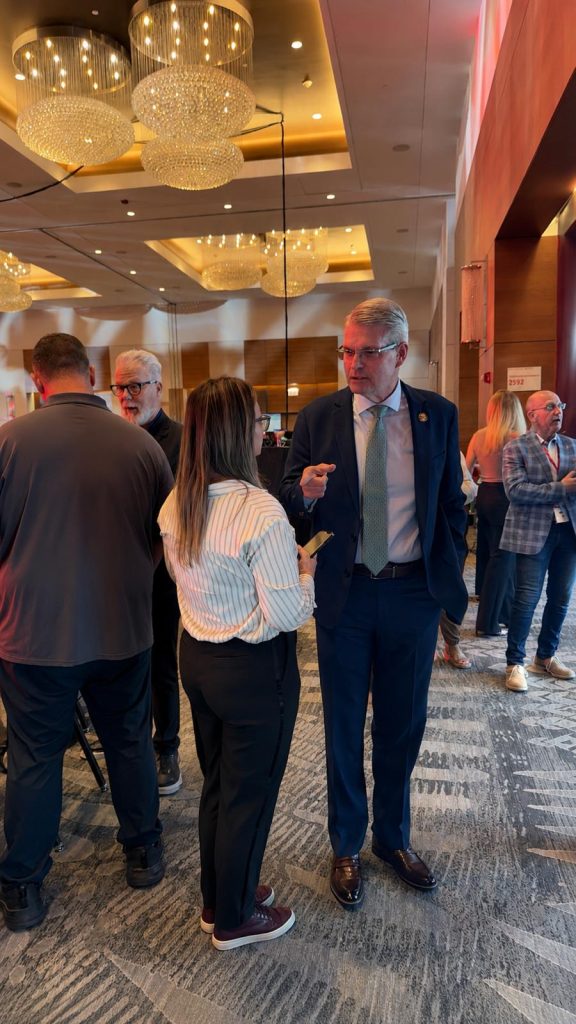
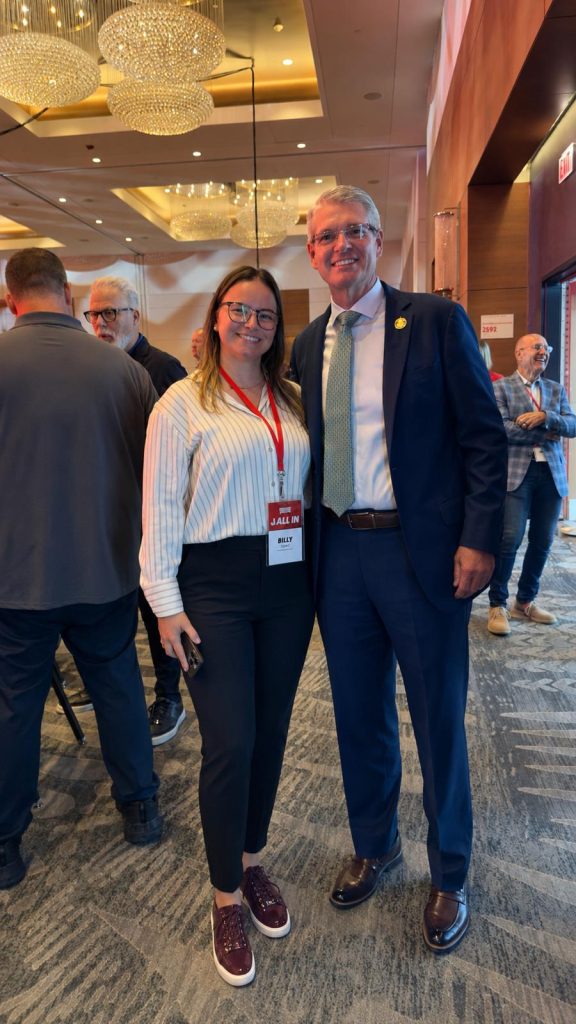
One of the highlights of the entire Summit for us was the chance to meet and talk directly with Derek Barrs, Administrator of the Federal Motor Carrier Safety Administration.
You don’t often get the head of the agency that writes the rules standing in front of a room full of carriers, taking unfiltered questions. He did exactly that — and the session on stage was blunt about where enforcement is heading.
The direction is not subtle. FMCSA has moved hard on driver qualification: CDL knowledge and skills tests are now administered in English only, with drivers required to be recertified in English, and the agency has been pursuing roughly nine regulatory actions spanning English-language proficiency standards, CDL testing, and new-entrant requirements. Barrs has framed it plainly: a CDL should represent real training, real qualifications, and real competency, and it should be issued in a way that resists fraud — because when loopholes exist, bad actors find them, and good carriers pay the price.
That last part is the piece that hits home for a carrier like us. Every fraudulent operator, every CDL mill, every chameleon carrier makes the market harder and more expensive for the companies doing it right.
And the enforcement isn’t theoretical. FMCSA is working with Homeland Security Investigations on a nationwide audit of the third-party skills testers that states use to grant commercial driver’s licenses, and nearly 30,000 drivers have already been placed out of service on English language proficiency grounds.
What we’re doing about it: re-auditing our own driver qualification files, ELP readiness, and onboarding process — not because we’re worried, but because “we thought we were fine” is not a defense at a compliance review.
Administrator Barrs, thank you for the time and for the straight answers.
Freight Outlook 2026-27: A Capacity Market, Not a Demand Market
Dean Croke of DAT opened the Summit with the freight forecast, and the message lines up with what carriers have been feeling on the road all year: rates are moving on supply, not demand.
The numbers back it up. Contract linehaul rates for dry van and refrigerated freight posted their largest June-to-July increases on record, even as freight volumes declined, and July spot linehaul rates excluding fuel averaged $2.39 per mile for dry van, $2.75 for reefer, and $2.90 for flatbed — with dry van spot and contract rates converging at the same $2.39 figure. As Croke put it, spot rates moving ahead of contract rates has historically signaled a tightening market, but this particular capacity-driven market has no clean precedent.
The structural picture is the same story from a different angle: demand remains uneven, but acute capacity tightness, driver scarcity, regulatory enforcement, and limited fleet expansion are supporting substantially higher truckload rates.
The carrier takeaway: the capacity coming out of this market is partly regulatory. Compliance is no longer just a cost center — it’s the entry ticket to the market that’s left.
Stolen: Inside the Cargo Theft Surge
If one session made the room go quiet, it was this one. Cargo theft specialist Gary Thomas and the FBI walked through where supply chain crime actually stands in 2026 — and the headline is counterintuitive.
Fewer thefts. Far bigger losses.
CargoNet documented 677 supply chain theft incidents across the U.S. and Canada in Q2 2026 — a 26% decline from Q2 2025 and 14% down from the previous quarter. But total estimated cargo losses more than doubled year over year to $304.6 million, up from $135.7 million, with the average reported loss reaching $564,009. The warning from CargoNet’s Keith Lewis was the line worth writing down: lower incident volume should not be mistaken for lower risk.
For context on the trend line, 2025 closed at roughly $725 million in estimated U.S./Canada cargo theft losses — a 60% jump over the prior year — across 2,646 confirmed incidents.
What’s Being Stolen
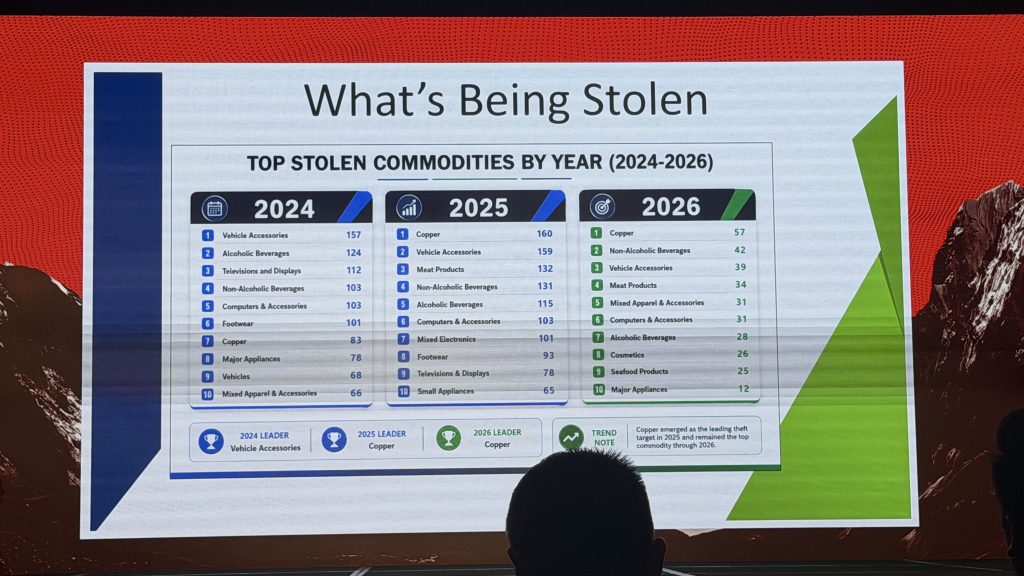
The commodity mix has shifted sharply toward high-value, easily resold freight:
- Metals — up. CargoNet recorded 80 metal thefts in Q2 2026, up from 54 a year earlier, with copper the most frequently targeted metal, alongside increases in aluminum, nickel, and tungsten.
- Enterprise technology. Organized rings continued to target computer and networking equipment and cryptocurrency mining hardware — loads worth millions that often move as ordinary dry freight, creating a serious mismatch between value and security profile.
- Personal care and beauty. This category posted the sharpest Q1 increase, jumping from 18 events to 50 — a 178% rise driven by cosmetics and fragrances, mostly in the Northeast.
- Food and beverage — down. Overall food and beverage theft declined.
The Cargo Theft Map
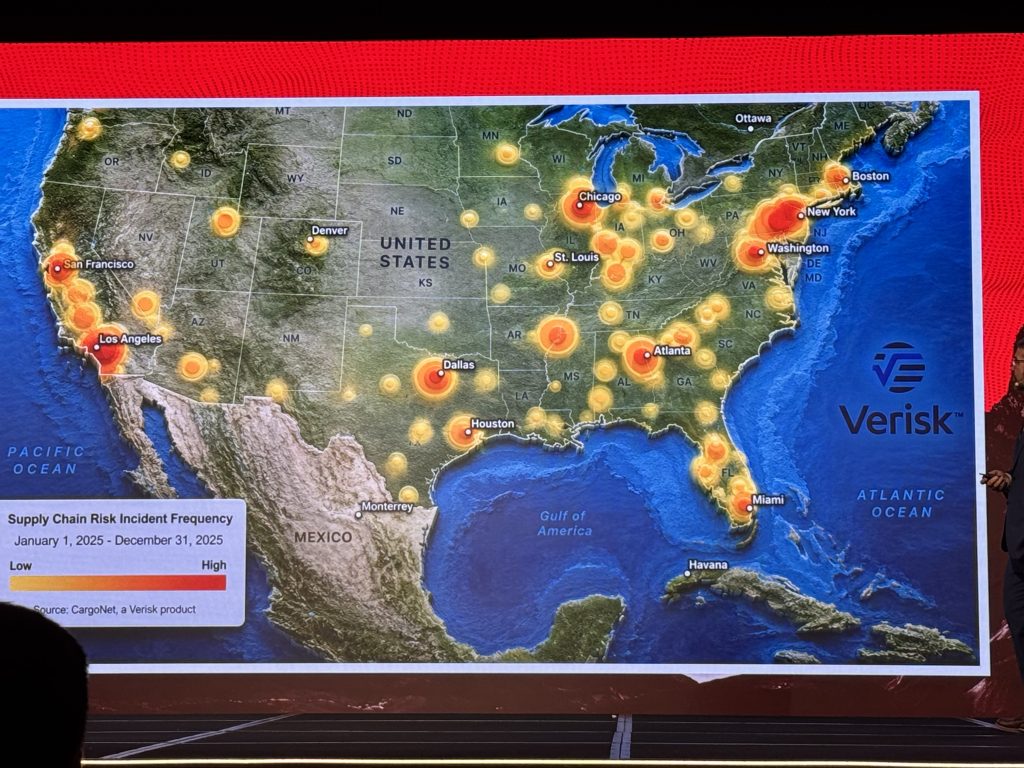
Geography matters more than ever, and the map is being redrawn by organized crime rather than opportunists. Among the top eight states, most saw year-over-year declines, with two exceptions: California rose from 255 to 277 incidents and New Jersey surged from 27 to 59 — a 119% jump. Texas dropped 22%, from 102 to 80, as the opportunistic theft historically common in the Dallas–Fort Worth and Houston corridors gave way to more targeted operations elsewhere. The pattern points to reduced activity from domestic criminal organizations in Texas and the Southeast, paired with sustained or growing activity by organized groups operating out of California and the New York City metro area.
How They’re Getting In
This is where it stops being a physical security problem and becomes an IT problem. Business email compromise remained the primary access point for the quarter’s most sophisticated schemes — compromised accounts hand criminals communication history, transportation plans, and the ability to impersonate trusted parties and alter shipment details. CargoNet expects impersonation-based fraud and the exploitation of legitimate carrier identities to remain central to cargo theft, with criminal networks expanding beyond the point of tender to vulnerabilities across the full shipment lifecycle.
Read that again: your MC number and your email inbox are now attack surfaces. Fictitious pickups and identity theft target the carrier’s good name as much as the freight.
What we’re doing about it: tightening pickup verification, locking down email and TMS access, treating high-value loads as a different risk class, and training our drivers on what a fictitious pickup actually looks like in the yard.
Targeted: Staged Crashes and Nuclear Verdicts
Joseph Baiocco of Wilson Elser covered the other side of carrier exposure — organized fraud rings running staged crashes as a business model, and the jurisdictions where plaintiff verdicts have escalated into eight- and nine-figure events.
The uncomfortable truth for every fleet: the outcome of a claim is often determined long before the accident. It’s determined by your telematics policy, your camera footage retention, your driver files, your post-accident procedure, and your contracts.
What we’re doing about it: reviewing our accident response protocol and our documentation discipline. Evidence you didn’t preserve is evidence the other side gets to characterize for you.
Case in Point: Regulations and Rulings Carriers Can’t Ignore
Greg Feary of Scopelitis closed the regulatory track with the cases carriers need on their radar — AB5 and the broker-carrier model, independent contractor classification across states, chameleon carriers, English proficiency, and where broker transparency regulation is heading.
If your business model touches owner-operators or brokered freight, these are not abstract legal questions. They’re structural questions about how you’ll be allowed to operate in 2027.
Leadership: On Fire and All In
Between the data and the regulations, two keynotes reframed everything.
John O’Leary — who survived burns across his entire body at age nine with less than a 1% survival rate — talked about the difference between surviving and thriving. In an industry where a lot of companies have spent three years just surviving, that landed hard.
Rorke Denver, retired Navy SEAL Commander with 13 overseas deployments and a Bronze Star with “V” for valor, closed with the principles that translate from combat leadership to running a trucking company when the pressure is highest.
Different lives. Same lesson: the standard you hold when nobody’s watching is the standard you actually have.
What AAM Network Is Taking Home
Five things going straight into our team meetings:
- Compliance is a competitive advantage. Enforcement is removing capacity. Clean carriers inherit the freight.
- Cargo security is now cyber security. Verify pickups, harden email, protect your identity as a carrier.
- Know your high-risk freight. Metals, electronics, and cosmetics are not ordinary dry van loads anymore.
- Document like you’ll be deposed. Because on a bad day, you will be.
- Read the market as a capacity story. Plan hiring, capex, and rate strategy accordingly.
Huge thanks to Cottingham & Butler for the organization, the caliber of the speakers, and the quality of the conversations in the hallways — which, as always, were half the value.
To everyone we met in Schaumburg: our door is open. Carrier to carrier.
AAM Network Inc. is a Chicago-area trucking and transportation company. Questions about anything in this recap — or want to talk shop about cargo security, compliance, or the freight market? Reach out. We’re happy to share what we learned.
#Trucking #CargoTheft #FMCSA #FreightMarket #Logistics #TruckingSafety #CBSummit #AAMNetwork