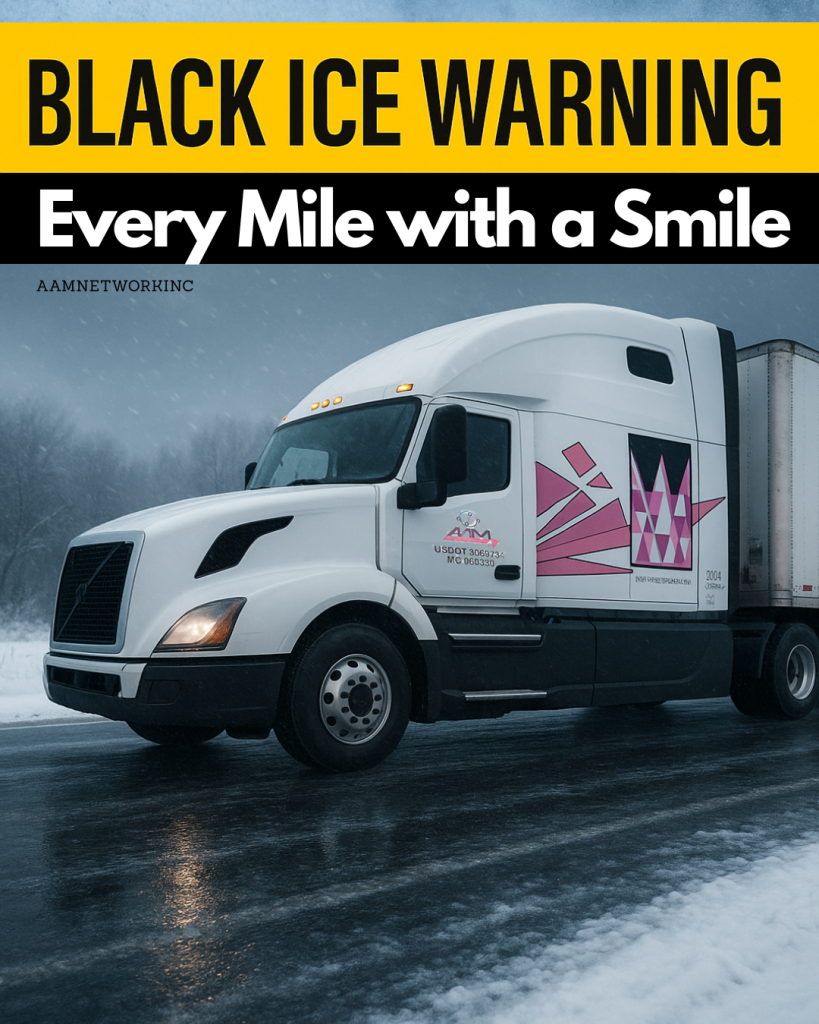
AAM BLOG
AAM NETWORK INC – Winter Safety Guide for OTR Drivers & Fleet Professionals
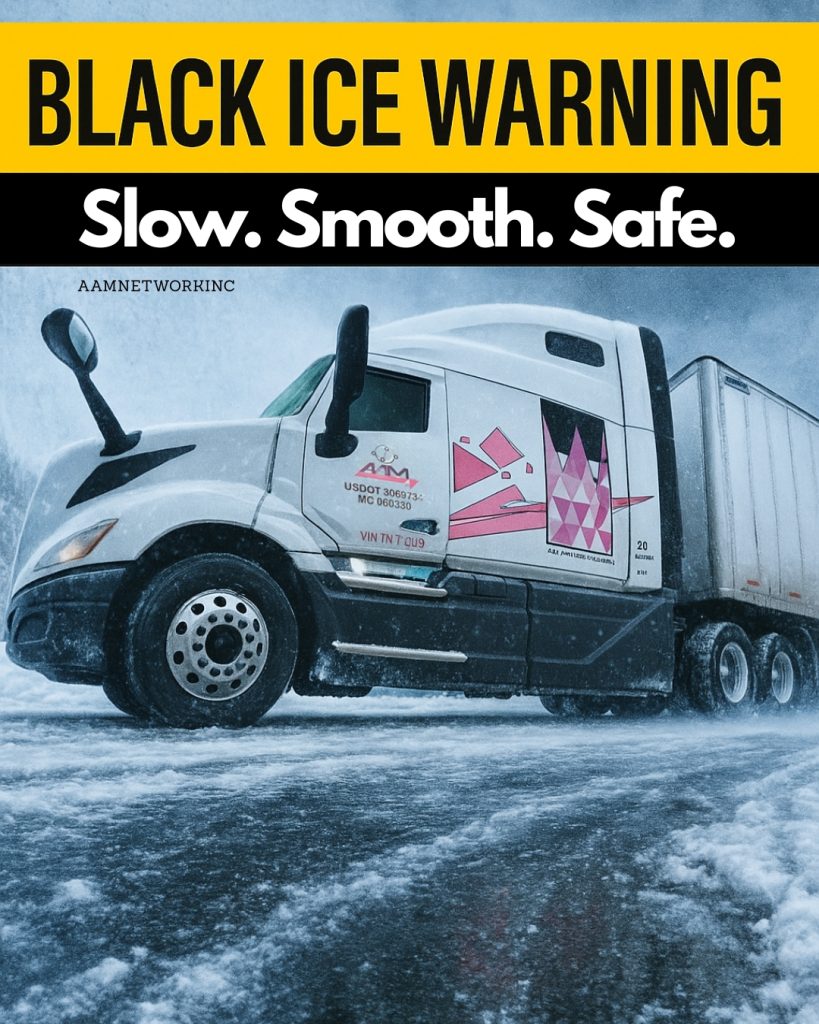
A truck doesn’t need deep snow or a frozen highway to lose control—sometimes, all it takes is a road that looks wet.
That’s black ice: thin, invisible, and responsible for thousands of winter crashes every year. For transport companies and OTR drivers, black ice isn’t “bad luck.” It’s a predictable winter hazard that demands preparation, awareness, and professional discipline behind the wheel.
At AAM NETWORK INC, safety isn’t a slogan—it’s part of the job. Our trucks run 48 states all year long, and winter operations require a different level of respect for the road. This guide summarizes real, on-road strategies used by experienced truckers to identify black ice early, avoid common mistakes, and recover safely if the truck begins to slide.
✅ What Makes Black Ice So Dangerous?
Black ice forms when moisture on the road freezes into a clear sheet.
It blends perfectly with asphalt.
It gives zero visual warning.
It removes traction instantly on an 80,000 lb vehicle.
One small skid can turn a controlled ride into a jackknife or chain-reaction pile-up. It has happened on highways from Chicago to Pennsylvania to Wyoming—every winter, the same pattern repeats itself: normal-looking pavement, sudden loss of traction, and no time to react.
Black ice most often develops:
✔ Early mornings or evenings
✔ When the temperature is 33°F and dropping
✔ After rain, melting snow, or freezing fog
✔ Near bodies of water, rivers, and open fields
✔ On bridges, overpasses, and shaded road sections
✅ Why Trucks Are More Vulnerable
Cars slide on black ice—semis accelerate on black ice.
- 80,000 lbs of mass creates unstoppable momentum
- Stopping distance becomes meaningless
- If one axle locks, the trailer can push the tractor sideways
- Engine brake, cruise control, or a sudden corrective turn can cause a spin
A loaded trailer gives stability in normal conditions.
On black ice, that weight becomes a liability.
One example: in January 2022, a black ice incident in South Korea involved 40+ vehicles. Several fatalities. Zero warning. The same conditions exist here every winter.
✅ Professional Rule #1: Detect Black Ice BEFORE You Hit It
A skilled driver reads the road like an instrument panel.
Watch for these real-world signs:
- Road looks wet, but no tire spray from vehicles ahead → you are rolling on ice
- Surface appears glossy, shiny, or “oily” → treat it as frozen
- Bridges and overpasses → always colder than normal highway
- Shaded areas from trees or cliffs → freeze and stay frozen
- Near water → moisture meets cold air = instant ice
If anything feels different—even a slight “float” in the wheel—assume the pavement is frozen.
✅ Professional Rule #2: Speed Wins Nothing on Ice
If you think you might be on black ice:
- Drop speed way below normal limits
- Add extreme following distance (10+ seconds)
- Stay smooth—no sudden steering, braking, or throttle changes
- Never use cruise control where ice is even a possibility
- Never touch the engine brake on slick pavement
Friction is already gone—don’t help it disappear completely.
✅ How to Handle a Slide on Black Ice
This part separates professionals from statistics.
✅ If the truck begins to slide:
✔ Take your foot off the accelerator
✔ Do not brake
✔ Do not clutch
✔ Keep wheels pointed where you want the truck to go
✔ Small steering corrections. No panic. No jerks.
Your goal is traction recovery, not “fixing” the skid.
Locked brakes turn a tractor-trailer into a sled.
✅ If the Trailer Starts to Jackknife
The trailer starts overtaking the tractor?
Your instinct will scream “brake harder.”
Do the opposite.
✔ Feet off all pedals
✔ Steer gently into the skid
✔ If space allows, a small, smooth power application may pull the tractor straight (advanced technique—only if you have room)
The calmer the driver, the faster the recovery.
✅ Pre-Trip: Winter Edition
A regular pre-trip is not enough in freezing weather. Winter demands a different checklist.
Tires
- Pressure drops 1–2 PSI for every 10°F temperature drop
- Underinflated tires = weak contact patch = no grip
- Winter-rated tires are not optional in real icy conditions
Brakes
- Check for uneven wear
- Inspect air hoses and chambers
- Even a “small” leak becomes a big problem in sub-zero air
Visibility
- Clean headlights and fog lights
- Clear brake lights and turn signals
- Make sure reflective tape is visible for night driving and blowing snow
In winter, other drivers must see you just as clearly as you see the road.
✅ After a Skid: The Part Most Drivers Forget
You saved the truck. Good.
Now stop driving.
Adrenaline makes people overconfident—and that’s when the second accident happens.
✔ Pull over at a safe location
✔ Hazard lights on
✔ Check tires, rims, brakes, and load
✔ Take 5–10 minutes to calm down before rolling again
A professional finishes the job safely—not quickly.
✅ Winter Threats Beyond Black Ice
Winter offers an entire menu of problems:
- Freezing rain
- Hardpack snow
- Slush hydroplaning
- Whiteouts
- Frost heaves
- Sudden temperature drops
- Potholes hidden under snow
- Wildlife crossing in rural areas
One bad decision in winter can undo an entire career of good ones.
✅ Be Ready: Winter Driving Checklist
Every professional should carry:
✔ Scraper & brush
✔ Warm gear (blankets, gloves, boots)
✔ Flashlight + batteries
✔ Food & water
✔ First aid kit
✔ Phone power bank
✔ Chains (where required)
✔ Sand or cat litter for traction
Winter is not the time to “hope for the best.”
✅ AAM NETWORK INC Safety Philosophy
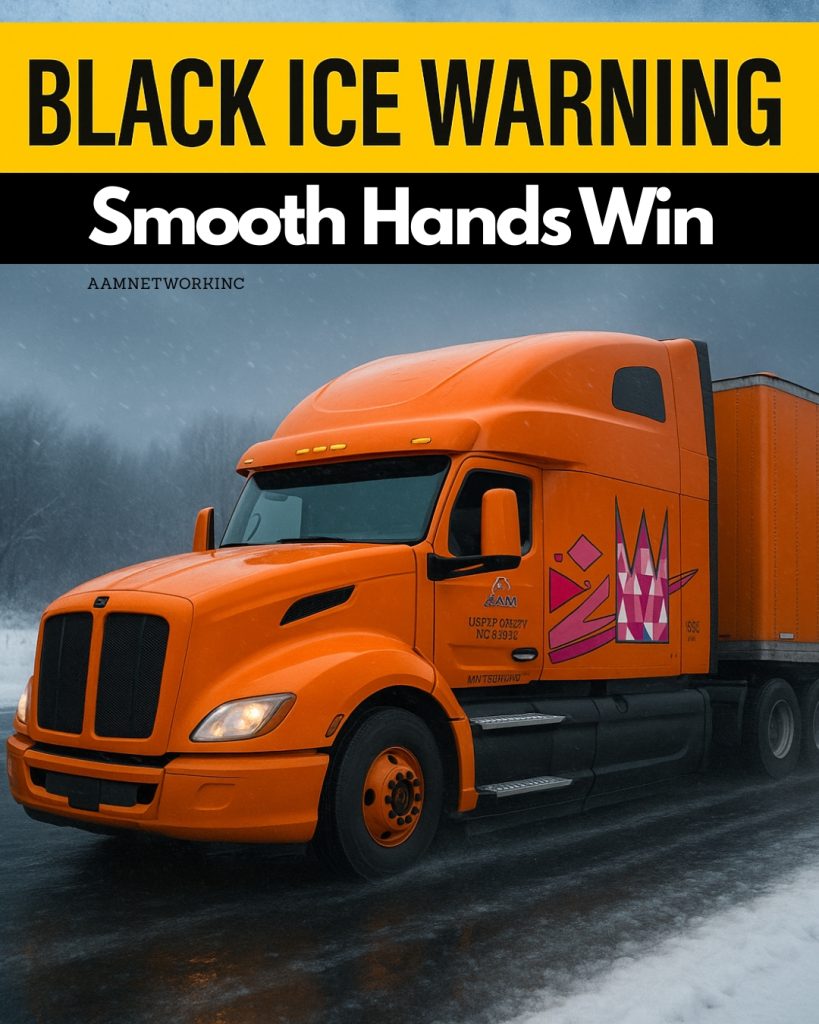
Slow is professional. Smooth is professional.
Finishing the trip safely is the only goal.
Our drivers operate 24/7 across the U.S. We run in mountains, snow belts, lake-effect corridors, and northern plains where temperatures drop fast and conditions change without warning. Black ice isn’t a surprise—it is predictable.
And predictable hazards can be managed.
Black ice doesn’t give second chances.
It looks harmless, attacks without warning, and punishes even small mistakes. Every winter mile should be driven with respect, patience, and professional discipline.
To every driver out there running loads through winter weather—we see you, we appreciate you, and we want you getting home safe.
Every Mile with a Smile.
That’s AAM NETWORK INC.