AAM BLOG
More than 1.1 million deer were hit on U.S. roads in a single year, and the worst stretch of the calendar is happening right now. For a professional driver at the wheel of an 80,000-lb rig, a deer in the headlights is not a fender-bender risk. It is a split-second decision that can end in a jackknife or a rollover.
This guide covers where and when deer strikes happen most, why they are more dangerous in a truck, and exactly what to do before, during and after an encounter. Share it with every driver you know.
Watch: Deer Season in 60 Seconds
The numbers behind deer season
Deer strikes are one of the most common crashes on American roads. These are the latest figures:
- 1.1 million+ deer collisions between July 2024 and June 2025, out of 1.7 million animal collision claims nationwide (State Farm, via Insurance Business).
- About 1.6 million animal collision claims in the most recent year (July 2025 to June 2026), with $1.9 billion in claim costs paid by State Farm alone (Carrier Management).
- More than 350,000 police-reported crashes, nearly 50,000 injuries and nearly 300 deaths each year involve a driver hitting or trying to avoid an animal, according to the AAA Foundation for Traffic Safety’s 2020 to 2024 analysis (Carrier Management). Most are believed to involve deer.
The real number of collisions is higher. Many strikes are never reported to police or insurers, and injured deer often leave the road before anyone counts them.
Why November is the most dangerous month
November is the peak month for deer-vehicle collisions, and October and December are close behind. Fall accounts for roughly 41% of all animal collision claims (CarInsurance.com, citing State Farm).
Two things drive the spike:
- The rut (mating season). Bucks chase does across roads with little regard for traffic. During the rut, deer can be on the move at any hour, not only at dawn and dusk (Oklahoma Department of Wildlife Conservation).
- The clock change. Daylight saving time ended on November 1, 2026. The evening commute now runs in darkness during the same weeks the rut peaks.
When deer are most active
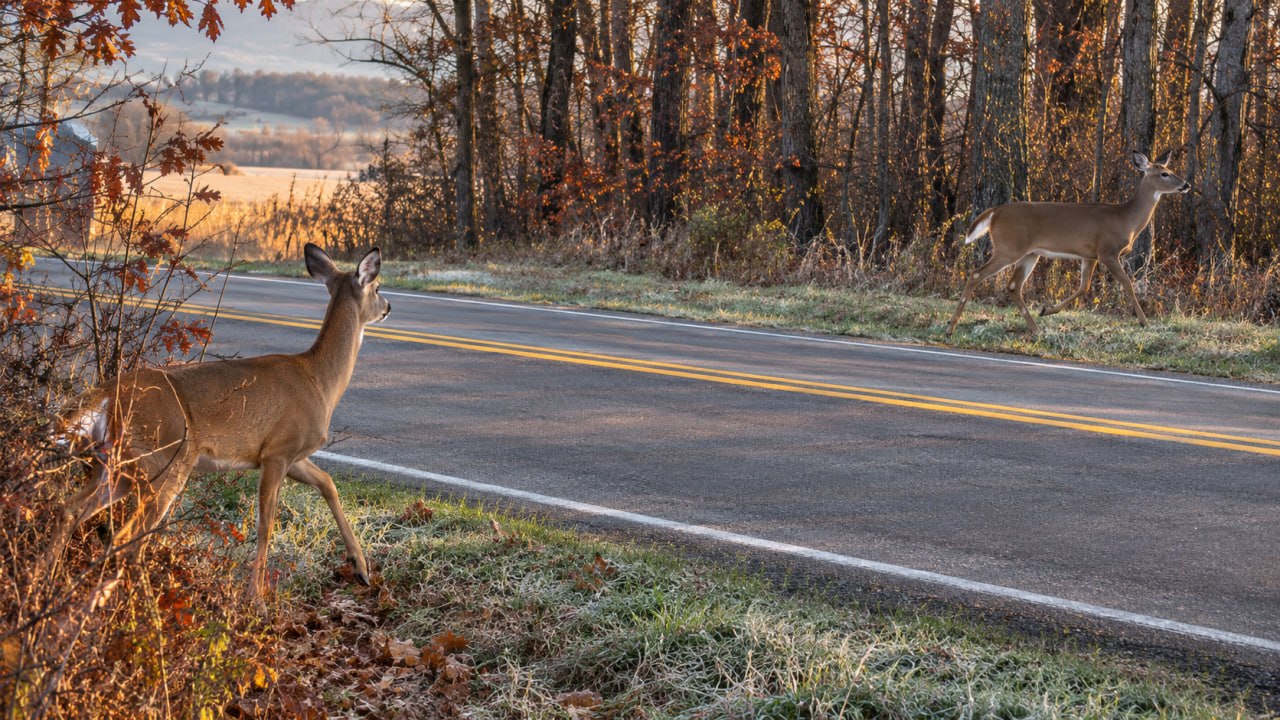
Deer are crepuscular: their activity peaks around dawn and dusk. The highest-risk windows are roughly 5 to 8 AM and 6 to 9 PM (WJLA). Penske Truck Leasing flags 5 PM to 9 PM as the most dangerous evening stretch for commercial drivers.
If your route and hours of service allow it, plan the riskiest rural stretches for full daylight.
Where deer strikes happen most
West Virginia has led State Farm’s ranking for more than a decade. Nationally, the odds of a driver hitting an animal in a year are 1 in 145 (WFTV).
| Rank | State | Odds of an animal collision (per driver, per year) |
|---|---|---|
| 1 | West Virginia | 1 in 46 |
| 2 | Montana | 1 in 54 |
| 3 | Wisconsin | |
| 4 | Pennsylvania | |
| 5 | Michigan | |
| 6 | Iowa | |
| 7 | Mississippi | |
| 8 | Virginia | |
| 9 | Maine |
The road matters as much as the state. Watch hardest where a highway runs between farm fields and woodland, along wooded corridors, and anywhere you see a deer crossing sign. Those signs mark spots with a history of strikes.
Why the stakes are higher in a truck
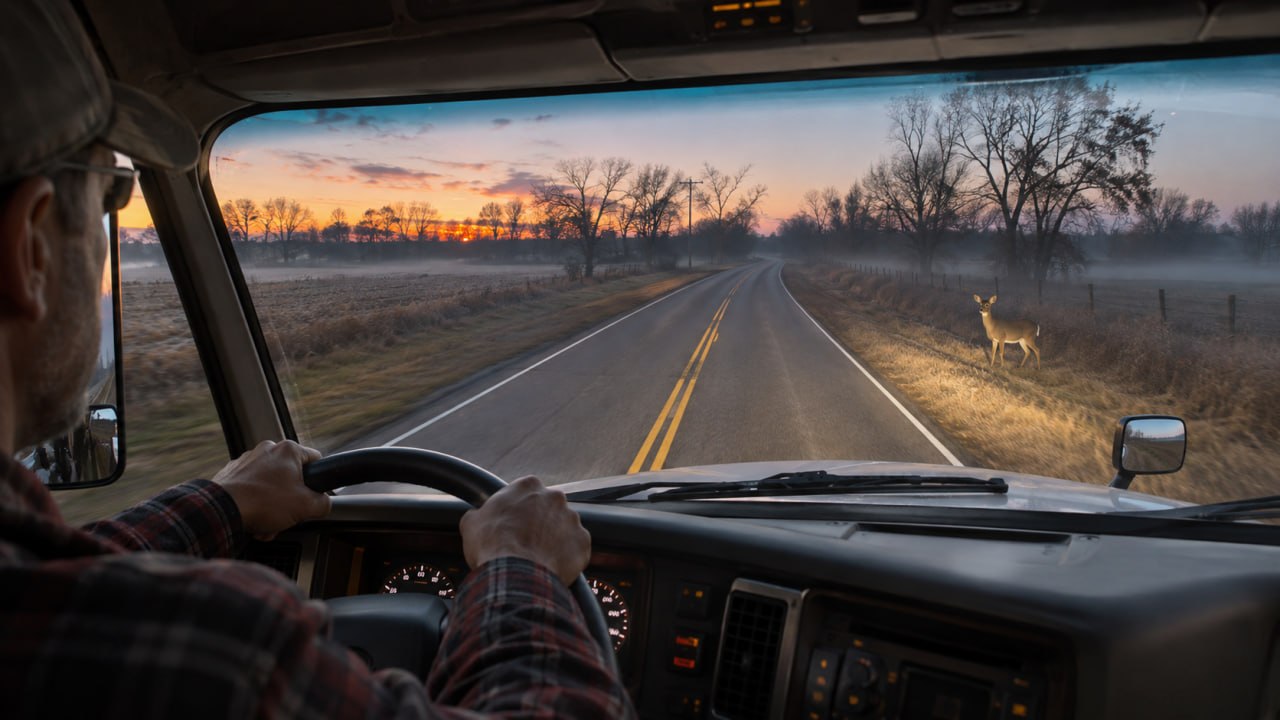
A passenger car that hits a deer usually ends up with a damaged hood and radiator. A truck driver faces a different set of risks:
- Weight and momentum. A loaded tractor-trailer can weigh 80,000 lbs. It needs far more distance to stop and reacts badly to sudden steering.
- Swerving is the real danger. A hard swerve at highway speed can roll the rig, jackknife the trailer or send it into oncoming traffic. Hitting the deer is almost always the safer outcome.
- Hidden damage. A strike can crack a radiator, break headlights, or damage air lines and wiring behind the bumper. A truck that looks drivable may not be safe to run.
- Night miles. Many long-haul runs cover exactly the hours when deer move most.
Deer in your headlights: what to do
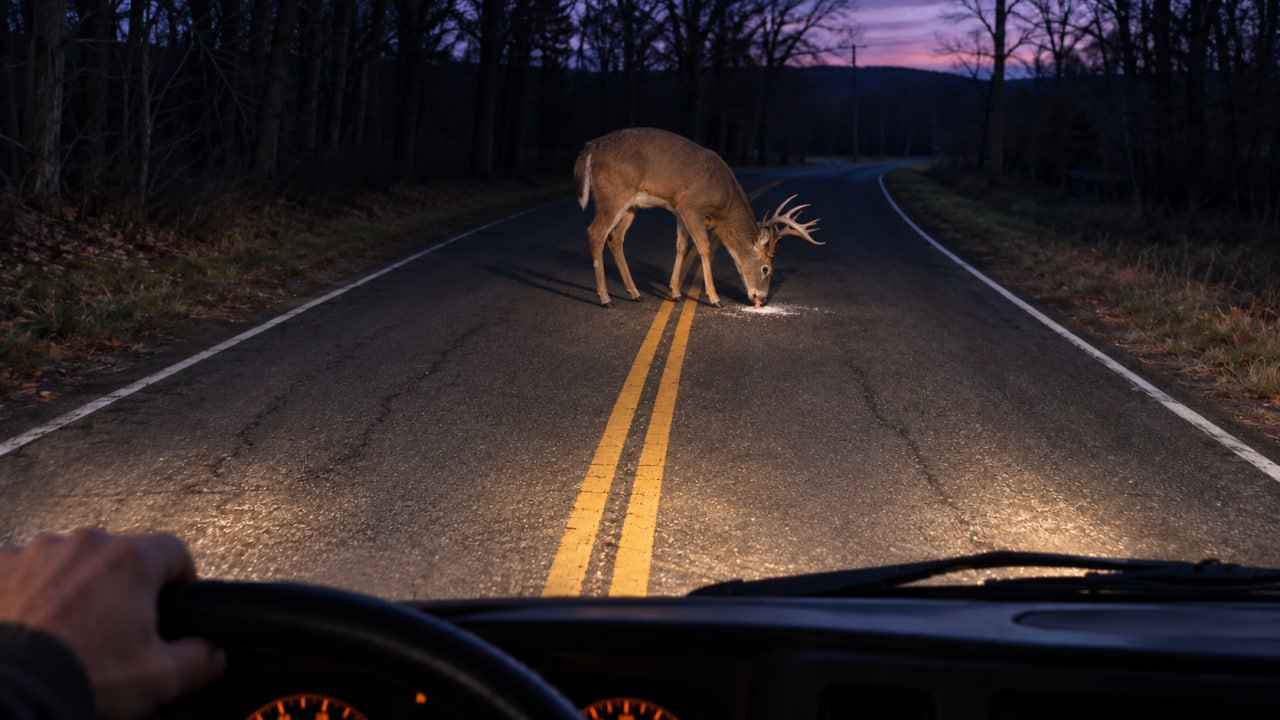
- Don’t swerve. Keep the wheel straight and stay in your lane. Safety agencies from Minnesota to Tennessee give the same advice: swerving is how a survivable collision becomes a serious one.
- Brake firmly and in a straight line. Slow down as much as you can while keeping control. If impact can’t be avoided, hit the deer rather than risk a rollover.
- Expect more than one. Deer travel in groups. If one crosses, slow down and watch for the next.
- Use your horn. One long blast can startle a deer off the road. Do not count on it.
- Don’t flash and swerve at the last second. A deer frozen in high beams may bolt in any direction. Hold your lane and keep braking.
Prevention habits for deer season
- Slow down at night, dawn and dusk. Lower speed buys you stopping distance.
- Scan the shoulders, not just the lane. Look for eye-shine and silhouettes along the ditch and tree line.
- Use high beams when there’s no oncoming traffic. They light up the shoulders and show reflecting eyes sooner.
- Heed deer crossing signs. They are placed where strikes have already happened.
- Skip the deer whistles. Studies show deer react no differently to vehicles that have them (Oklahoma Department of Wildlife Conservation).
- Consider a deer guard. Aluminum or steel grille guards can limit front-end damage on medium and heavy trucks (Nationwide).
- Always buckle up. A seat belt is your best protection if a strike turns into a crash.
After a deer strike: checklist for truck drivers
- Get safely onto the shoulder and turn on your hazard lights. Put out warning triangles if the truck can’t be moved.
- Stay away from the animal. An injured deer can kick or charge. Do not try to move it.
- Call 911 if anyone is hurt or the deer or debris is blocking a lane.
- Inspect the truck before you move: radiator and coolant, headlights and markers, air lines, hoses and wiring behind the bumper, hood latches.
- Call dispatch and your safety department to report the strike and get instructions.
- Document everything. Take photos of the truck, the scene and the location for the report and the insurance claim.
Deer season is not the only seasonal risk worth a pre-trip refresher. See our checklist from Brake Safety Week 2026 for the inspection points that keep a rig stopping the way it should.
Share this before your next run
A two-minute read can get someone home safe tonight. Share this article and the video with your fellow drivers, your family members who drive at night, and your team.
At AAM Network, safety is part of every mile we run. Want to drive for a carrier that puts its people first? See our open driver positions or learn more about AAM.
Stay sharp out there, drivers. Every Mile with a Smile.
FAQ: deer season and truck drivers
Should you swerve to avoid a deer?
No. Brake firmly in a straight line and stay in your lane. In a loaded truck, a swerve can cause a rollover or a crash with oncoming traffic, which is far more dangerous than hitting the deer.
What time of day are deer most active?
At dawn and dusk, roughly 5 to 8 AM and 6 to 9 PM. During the fall rut, deer can move at any hour.
What month has the most deer collisions?
November. October and December follow, and together the three months account for about 41% of animal collision claims.
Which states have the most deer collisions?
West Virginia ranks first (1 in 46 drivers per year), followed by Montana, Wisconsin, Pennsylvania and Michigan, according to State Farm’s 2025 to 2026 data.
Do deer whistles work?
No reliable evidence says they do. Studies found deer react the same way to vehicles with and without them.
What should a truck driver do after hitting a deer?
Pull onto the shoulder with hazards on, stay away from the animal, call 911 if anyone is hurt or a lane is blocked, inspect the radiator, lights and air lines, and report the strike to dispatch.
Sources
- State Farm animal collision data (via Insurance Business and Carrier Management)
- AAA Foundation for Traffic Safety, animal crash analysis 2020–2024
- State Farm state rankings 2025–2026
- CarInsurance.com, seasonal share of animal collision claims
- Oklahoma Department of Wildlife Conservation, the rut and deer whistles
- WJLA and Penske Truck Leasing, high-risk hours
- Nationwide, deer guards and fleet advice